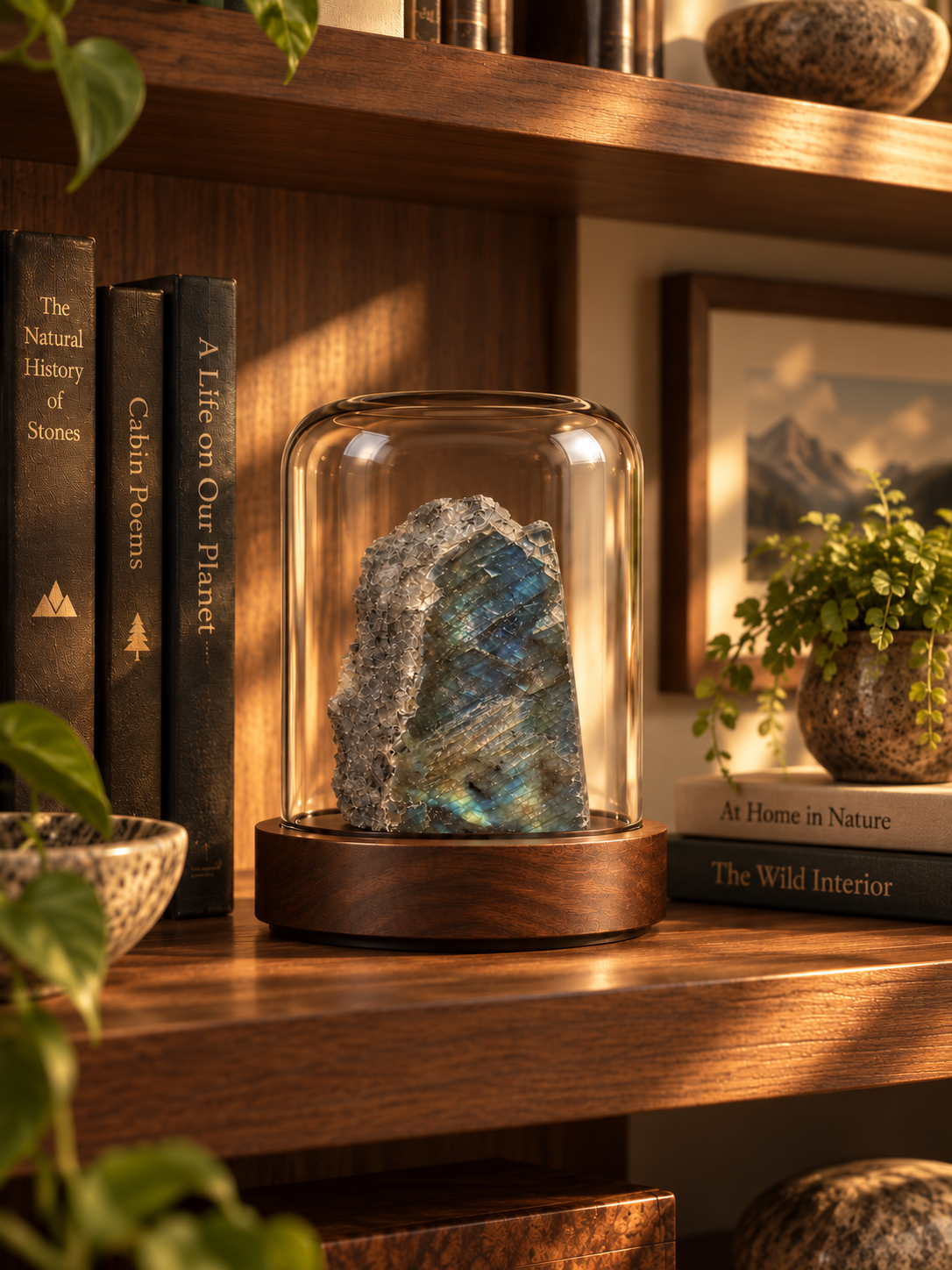
Labradorite
Turn it slowly and a hidden flash of blue and gold rises to the surface, then disappears.
Choose an edition
Payment is collected when you reserve.
First collection ships beginning December 2026. Most first-collection orders are expected to ship December 2026-January 2027. Cancel anytime before shipment for a full refund.
- Feeling
- Wonder
- Origin
- Madagascar
- Treatment / Finish
- One polished presentation face; remaining surfaces natural
In the Home
Where it belongs
Labradorite belongs where the light moves through the day - a desk beside a window, a shelf that catches the late sun. It rewards the person who walks past it twice and looks the second time.
Formation
How it came to be
It forms in the slow-cooling hearts of ancient basaltic intrusions, deep in the crust where molten rock loses its heat over thousands of years.
Labradorite is a feldspar - one of the most common mineral families on Earth - but a rare and particular one. It crystallises as mafic magma cools slowly underground, allowing microscopic layers of differing composition to separate within the growing crystal.
First described in the 18th century from the coast of Labrador, it is now found in quantity in Madagascar. The stones we select are typically hundreds of millions of years old.
Its signature optical effect has a name of its own: labradorescence - the shifting play of colour that appears only at certain angles.

The Object
The flash is not a surface trick. Light entering the stone is scattered by fine internal layers and returned as colour. Each specimen is a rough natural chunk with a single polished presentation face, cut and finished so the flash reads clearly while the remaining surfaces stay rough and natural.
Closer In
Under magnification the interior reveals parallel lamellae - twinned layers that split incoming light into its spectrum.
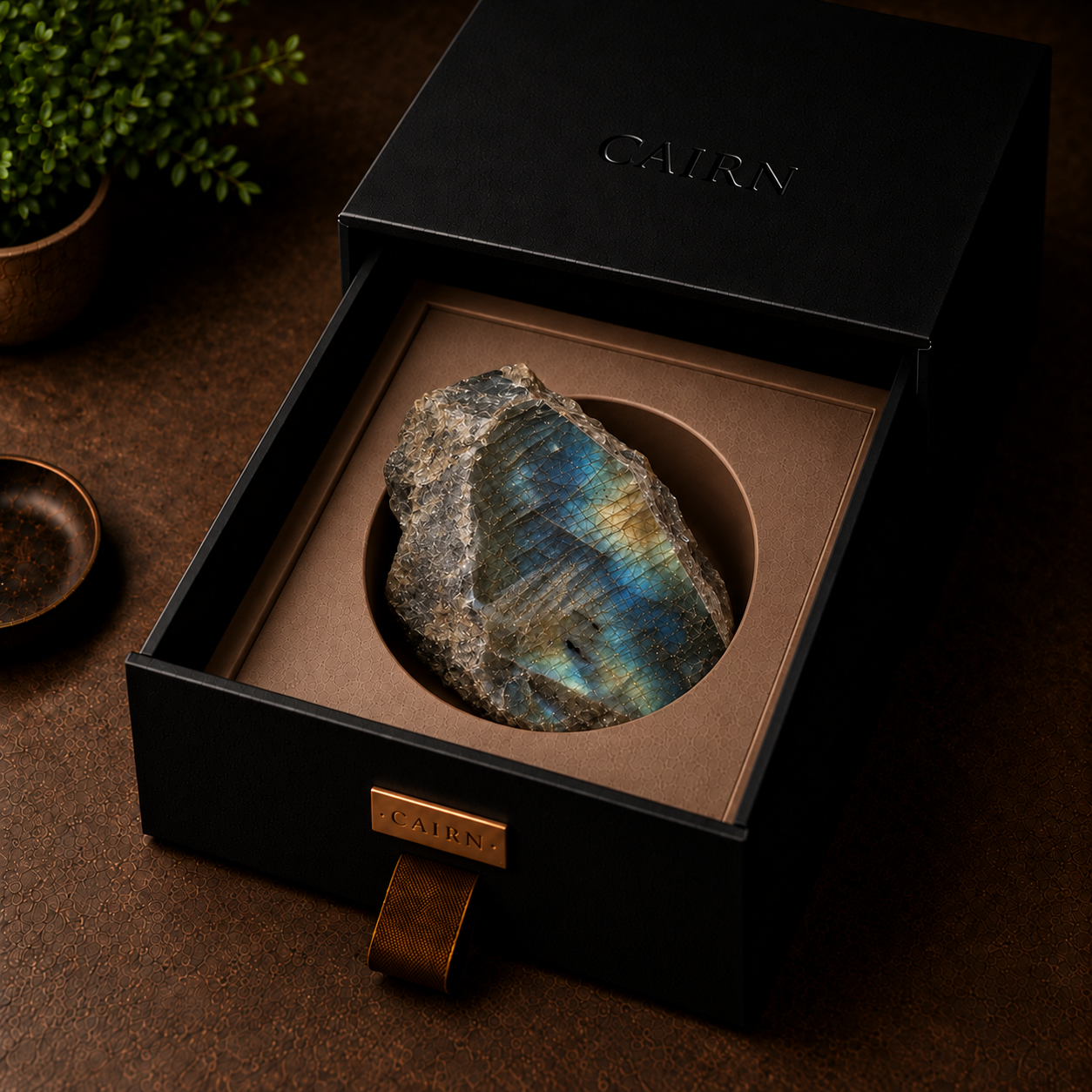
Packaging
Designed to be kept, not discarded.
- Museum-inspired specimen card
- Object provenance and formation notes
- Protective presentation materials
- Designed to be kept, not discarded
You may also notice
From the Journal