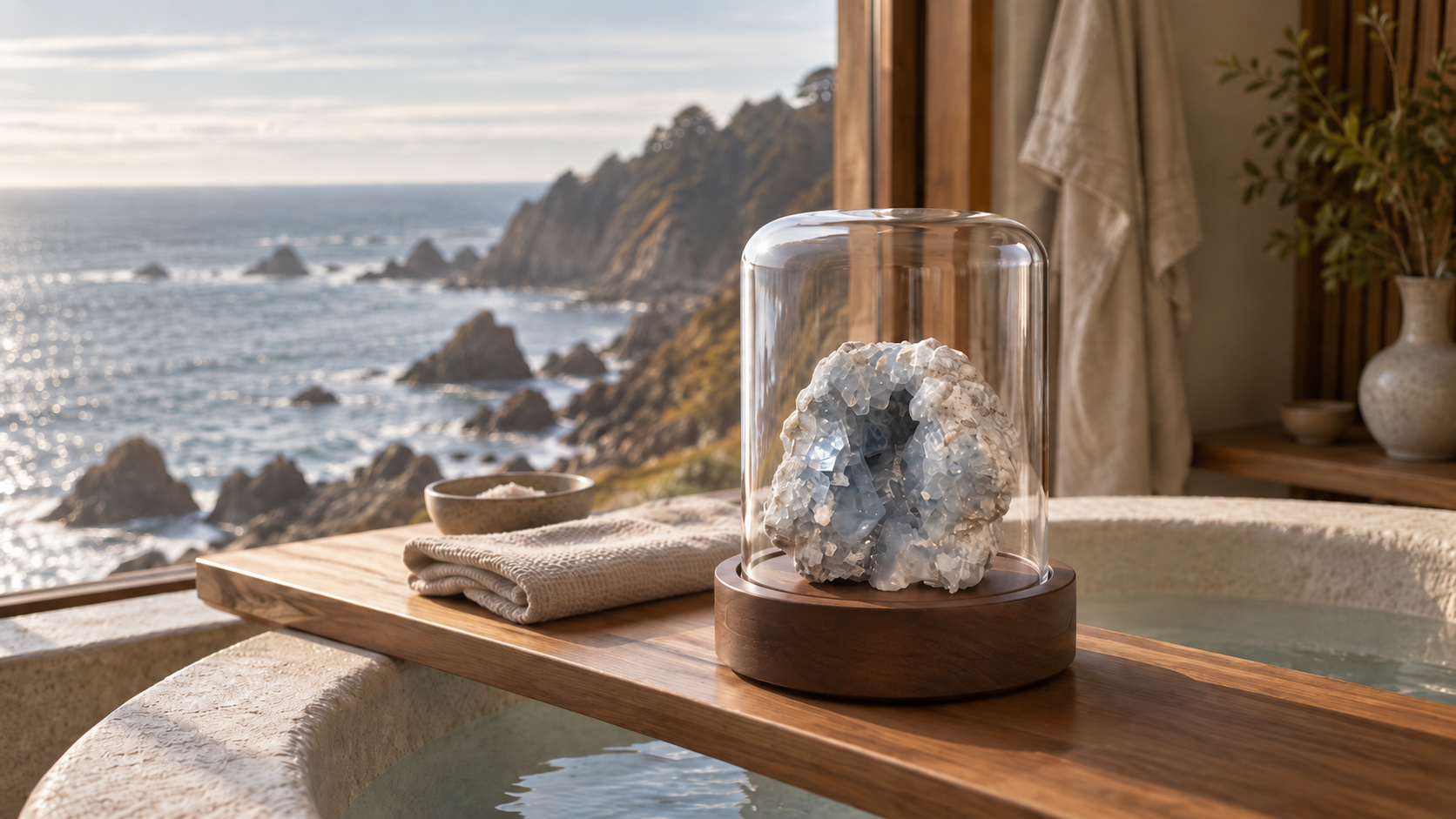
Celestite
A soft sky-blue you rarely see in stone, kept inside a plain grey shell.
Choose an edition
Payment is collected when you reserve.
First collection ships beginning December 2026. Most first-collection orders are expected to ship December 2026-January 2027. Cancel anytime before shipment for a full refund.
- Feeling
- Quiet
- Origin
- Sakoany, Madagascar
- Treatment / Finish
- None
In the Home
Where it belongs
Celestite asks for gentle, indirect light - a quiet corner or reading table away from harsher afternoon sun. Its colour is delicate and looks best when it is not competing.
Formation
How it came to be
It grows within sedimentary cavities, crystallising from strontium-rich waters percolating slowly through ancient marine limestone.
Celestite is strontium sulphate, and its name shares a root with celestial - a reference to its characteristic pale blue.
The finest geodes come from Sakoany in northwest Madagascar, where nodules formed in Jurassic-era sediments. When opened, they reveal an interior lined with tabular crystals.
The blue is subtle and can fade in strong direct sunlight, which is part of why it is best kept in softer light.
The Object
We select geode sections where the crystal termination is clean and the blue is even, with a rough natural shell that frames the colour.
Closer In
Closer in, each crystal shows crisp tabular faces meeting at precise angles - orderly geometry beneath the softness of the colour.
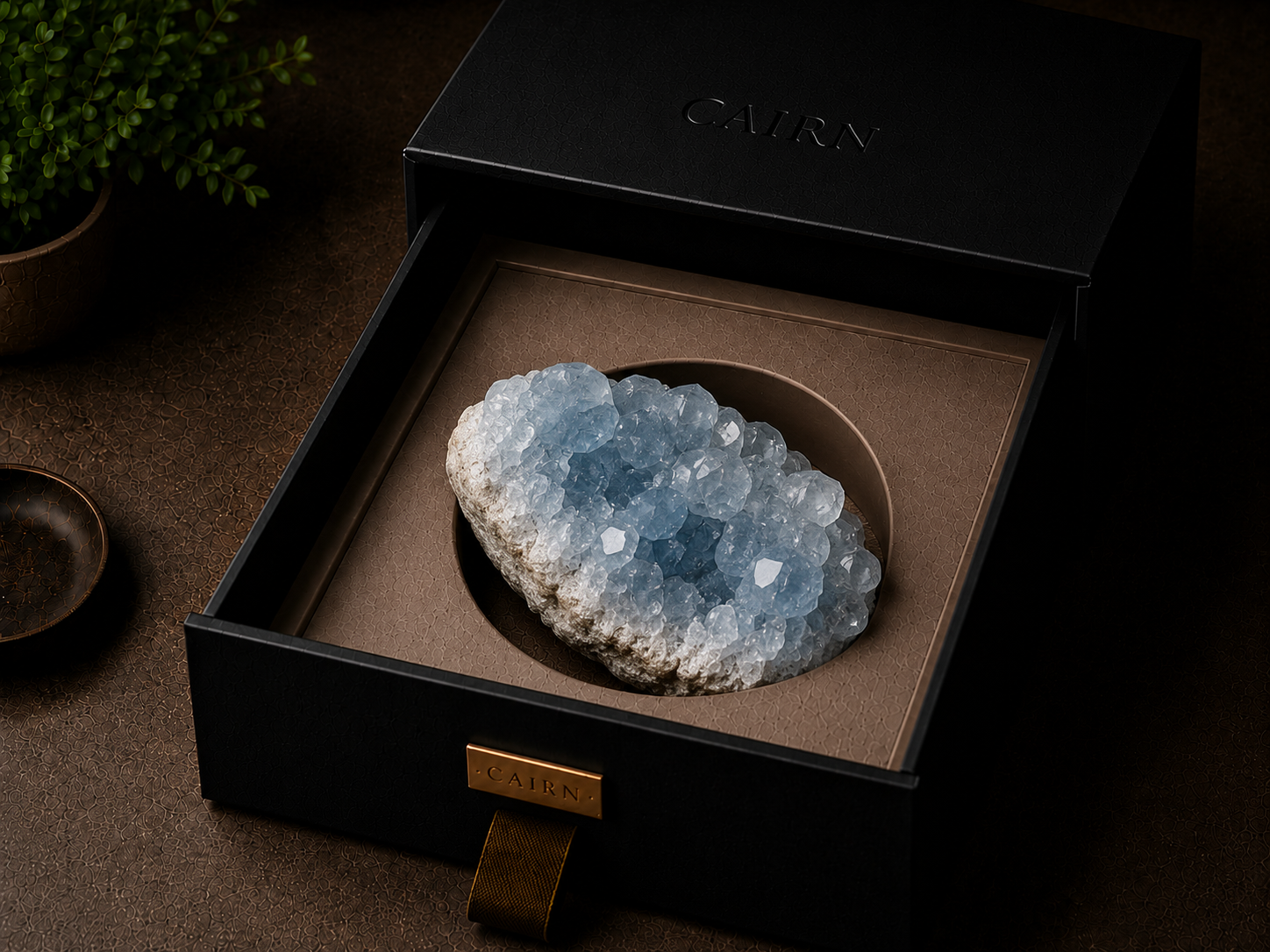
Packaging
Designed to be kept, not discarded.
- Museum-inspired specimen card
- Object provenance and formation notes
- Protective presentation materials
- Designed to be kept, not discarded
You may also notice
From the Journal